Ground Conditions – How to Decide Your Build-Up
This section walks you step by step through assessing your own ground so you can decide:
- which grid thickness to use
- how deep your sub-base needs to be
- whether you need reinforcement under the sub-base
- which membranes go where
By the end of this section, you should be thinking:
“I know what depth I need and exactly how my layers should be laid.”
Step 1: Choose the correct grid thickness
For most domestic projects, this decision is straightforward.
Grid thickness (realistic guidance)
40 mm grids
This is the sensible default for:
- driveways
- parking areas
- most domestic bases
This is what I used for my driveway and what I would use again in most cases.
30 mm grids
Only really suitable for:
- paths
- very light-duty bases (small sheds, bins, walkways)
The cost saving is small, so personally I wouldn’t scrimp unless the load is genuinely light and your budget is extremely tight.
50 mm grids
Generally unnecessary for domestic use.
These are aimed at:
- commercial areas
- car parks
- repeated heavy vehicle traffic
If you’re unsure, choose 40 mm.
Step 2: Assess your ground (no testing required)
You don’t need professional ground testing. You can learn a lot just by paying attention while excavating.
Check A: How does the soil feel?
- Very soft – wet soil easily squeezes through fingers
- Soft – moulds easily with finger pressure
- Medium – needs firm pressure to mould
- Firm / stiff – barely moulds, can only be indented
Check B: What happens when you stand on it?
- Sinks more than 50 mm → soft or very soft ground
- Sinks around 25 mm → medium ground
- Barely moves → firm ground
Step 3: Decide your sub-base depth
Use this as a practical rule, not an engineering specification.
Medium to firm ground (most gardens and driveways)
- 100–150 mm sub-base
- Compacted in layers
This is what I used for my driveway (150 mm) and it is solid.
Soft ground
- 150–200 mm sub-base
- Extra attention to compaction
- Consider reinforcement membrane (explained in next step)
Very soft ground
- 200 mm+ sub-base
- Reinforcement strongly recommended
For light-duty bases (such as a shed base) on good ground:
- 75–100 mm can be sufficient
If you’re unsure, add depth. It’s far cheaper than fixing movement later.
Step 4: Decide if you need reinforcement
This depends entirely on ground softness.
Medium or firm ground
- No reinforcement required
Soft or very soft ground
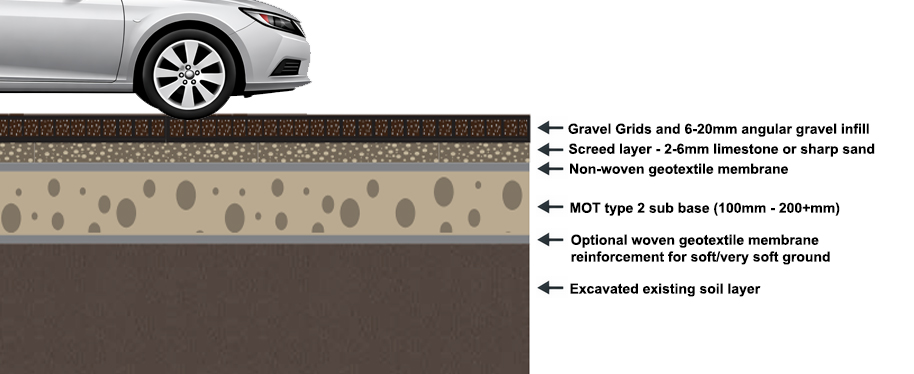
- Add reinforcement under the sub-base
This can be:
- a woven geotextile membrane, or
- a ground reinforcement grid
The purpose is to spread load and stop the sub-base pressing into weak soil. In most cases a decent woven geotextile membrane will do the trick.
Step 5: Normal layer order (most domestic installs)
From bottom to top:
- Natural ground (formation level)
- Optional woven membrane (only if ground is soft)
- Sub-base (Type 2 suits most DIY installs)
- Non-woven geotextile membrane
- Screed layer
- Gravel grids (typically 40 mm)
- Gravel infill